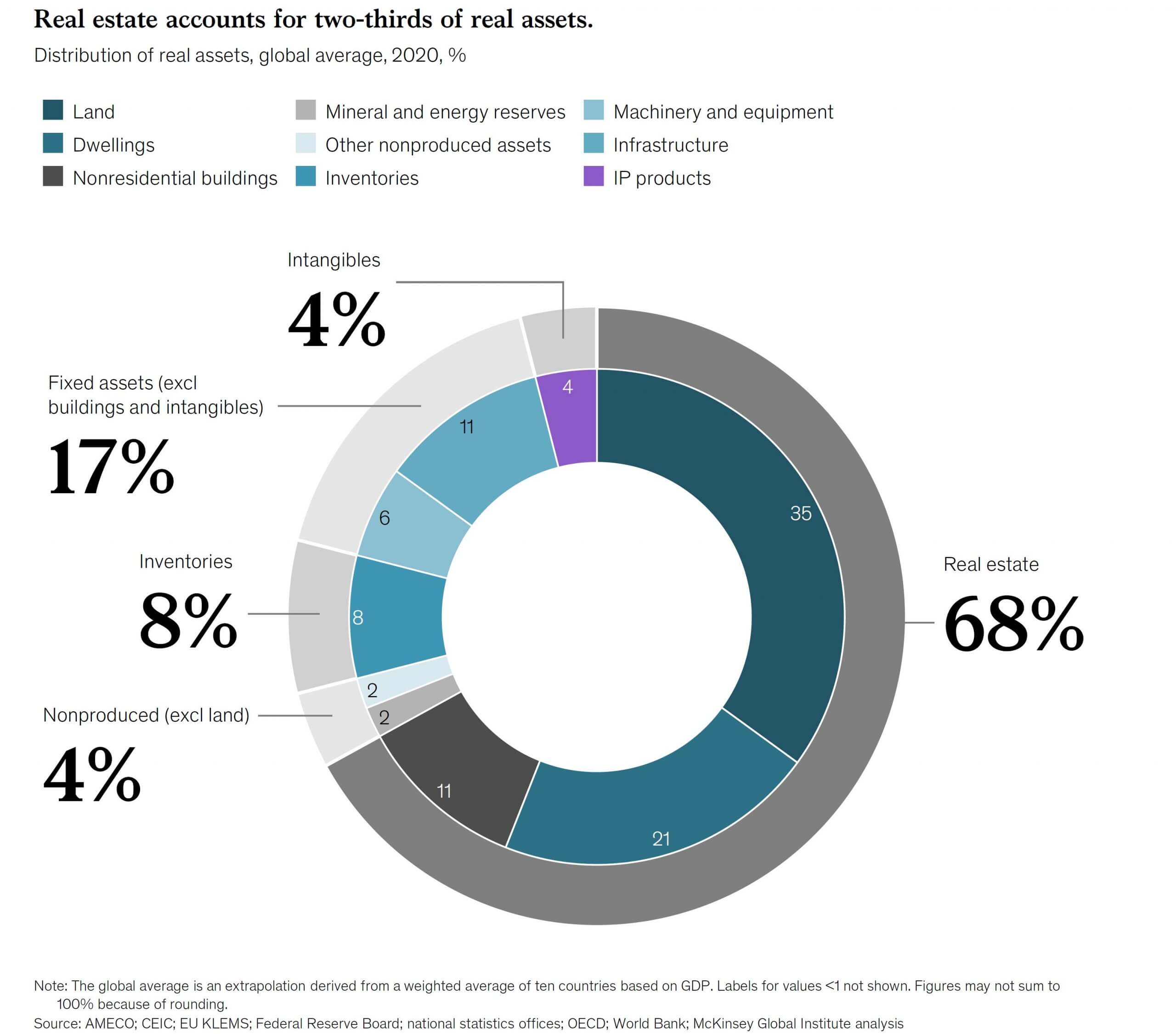
In the last 20 years, the world’s net assets have tripled “but not as a result of investment productivity, but as a result of increased real estate valuation.” Thus, according to McKinsey Global Institute (MGI) analysts, about two-thirds of the world’s net worth is deposited in real estate.
One of the statements of the analysis is that “the historical link between the increase in the value of assets and economic growth no longer exists.” This statement is based on the study of 10 countries, analyzed as 10 company balance sheets, which concentrate 60% of world revenues.
The value of the assets in the “aggregate balance sheet” of these 10 countries has tripled to $ 510 trillion in 2020. The figure is 6.1 times higher than their cumulative gross domestic product (GDP). In 2000, the value of assets was 4 times higher than GDP, which shows that the value of GDP increased much less compared to the growth of assets.
Two thirds of the consolidated balance sheet of the 10 countries (Australia, Canada, China, France, Germany, Japan, Mexico, Sweden, the United Kingdom and the USA) are stored in real estate. As their price increased, so did their wealth.
On the other hand, “only 20% of global net worth is invested in other fixed assets, which raises the question of whether companies use their wealth productively. The value of the residential properties amounts to half of the value of the assets, and that of the other buildings and lands, another 20% ”, it is specified in the MGI report.
And “the assets that drive most of the growth (infrastructure, structures and industrial equipment) stocks and reserves of raw materials cover the rest.”
Although digitalization is increasingly present, “intangible” assets occupy only 4% of the world’s balance sheet, which shows that the balance sheets have not increased based on the digitalization of the economy, but because of rising prices. Thus, in an economy although driven by intangible assets (software, intellectual property), no targets for capital investment could be found to offer better returns than real estate.
Moreover, as the MGI analysis shows, for every dollar invested in new net assets over the past two decades, total liabilities have increased by almost $ 4, of which about $ 2 is debt.
Financial assets held outside the financial sector grew much faster than GDP and on average 3.7 times as much as net investment between 2000 and 2020.
The question raised by MGI is whether the rupture between the value of net assets and economic growth is a sign of change in the economic paradigm, or is a signal that world leaders (political and economic-financial) must find solutions to make the world’s wealth more productive, in the sense of being used as a source of development.
“For decision-makers, rebalancing would require removing barriers to investment, such as sustainability and affordable housing. There are already tools to achieve this: reforming regulations; the levers for taxing capital and property gains in relation to income; and more seriousness regarding carbon prices and regulation “, is the conclusion of the MGI study.
4 Factors That were Boosting House Values
According to most specialists in the Real Estate sector, houses prices will keep rising steadily in 2022, and there are four factors that will make such a trend likely. They include low mortgage rates, relaxed lending standards, tight inventory, and the COVID-driven rise of remote work.
1. Low mortgage rates
Three years ago, during the last four months of 2018, a mortgage rate of 4.8% to 5% was considered a “good deal.” But rates have fallen considerably since then. Low mortgage rates, and the resulting demand among buyers, is just one reason why home prices will likely keep rising in 2022.
Although the National Bank of Romania intends to tighten from 1 January 2022 the conditions for contracting real estate loans for the purchase of homes that are not intended as a main residence by raising the minimum contribution of the owner to 25% for loans in lei, 35% for those in euros and 50% for those in another currency, the mortgage rates would still remain an encouraging factor.
2. Loosened mortgage standards
According to numerous reports, mortgage lending standards have eased a bit over the past year. This is creating more leverage for buyers leading to more demand.
The low cost of borrowing makes home purchases more affordable than rents and other investments. In addition, many households, especially those already in good standing, have accumulated significant savings since the beginning of the pandemic, because the lockdown limited spending.
3. An ongoing inventory shortage
Tight inventory conditions within the housing market are another reason home prices should keep rising in 2022. And this topic needs no introduction. Supply shortages have generated countless news headlines over the past year.
There are several reasons for the ongoing inventory shortage. A lack of construction is one of them. New home construction started to rebound earlier in 2021. But supply-chain snags and others issues have put a damper on that trend.
Even if construction does ramp up over the coming months, as some believe it will, it won’t be enough to fully resolve the supply shortage. That’s the third reason why home prices will probably keep climbing in 2022.
4. The work-from-home trend
Lastly, we have the rise of remote working. The work-from-home revolution has spurred the housing market in several ways. Mainly, it has given people a newfound freedom to choose where they live.
Remote employees who previously had to rent due to high home prices near their work locations can now migrate to more favorable housing markets. This has led to a surge in buying activity over the past year. In addition to boosting sales, this trend has put steady upward pressure on prices.